Nigeria has a rich and complex history deserving to be told by Nigerians, for Nigerians, and shared with the world. However, too often, we see our historical materials: documents, photographs, books, and newspapers that perfectly and accurately capture our past, hidden and locked away in archives, making them inaccessible to the very people whose stories they tell.
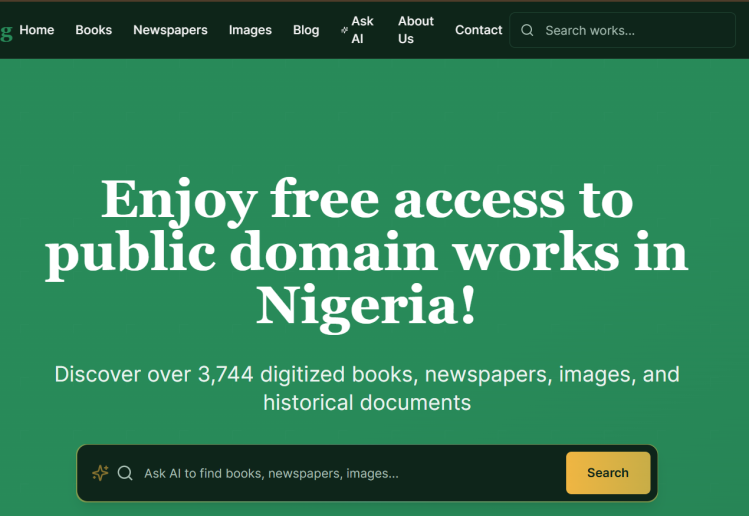
Free Knowledge Africa is proud to introduce publicdomain.ng, a digital platform that makes Nigerian Public domain materials freely accessible to everyone, everywhere.
What is PublicDomain.ng?
Publicdomain.ng is a comprehensive collection of Nigeria’s historical and cultural materials that have entered the public domain, meaning they are free of all intellectual property rights, making them available for anyone to access, use, download, and build upon. This collection includes books, magazines, newspapers, photographs, and government documents, and it is growing day by day.
Our mission for launching this platform is simply to democratise access to Nigeria’s documentary heritage and ensure that knowledge about our past is truly free and available to all
What You’ll Find on Publicdomain.ng
The platform currently houses diverse materials across several categories, including:
Historical Newspapers: Among our most exciting collections are newspapers from the 1940s and 1950s that represent a pivotal period in Nigeria’s journey toward independence. These publications offer firsthand accounts of the political movements, social changes, and everyday life during the pre-independence era. Researchers, students, and history enthusiasts can now explore how Nigerians documented their times in their own words.
Government Documents: Official gazettes and government publications that provide crucial documentation of Nigeria’s administrative and legal history.
Images and Photographs: Visual documentation of Nigeria’s past, capturing people, places, and moments that have shaped our collective story.
Why Does Publicdomain.ng Matter?
For Researchers and Academics
This collection provides primary source materials that have been difficult or impossible to access. No more traveling long distances to archives only to find materials unavailable. No more relying solely on foreign archives’ collections about Nigeria. These materials can now support dissertations, research papers, and scholarly work that centers on Nigerian perspectives.
For Educators and Students
Teachers can incorporate authentic historical documents into their lessons. Students can engage directly with primary sources rather than relying only on textbooks. History becomes more immediate and tangible when you can read the actual newspapers from 1950 discussing the independence movement.
For GLAM Professionals
Librarians, archivists, and museum professionals have a model for how digitized collections can be shared openly. This collection demonstrates the impact of making cultural heritage accessible and provides a platform for collaborative digitization efforts. We actively seek and welcome partnerships with institutions across Nigeria and Africa to expand these collections.
For Everyone
Cultural heritage belongs to all of us. Whether you’re a writer seeking historical inspiration, a family historian tracing your roots, a journalist researching context, or simply someone curious about Nigeria’s past, these materials are now yours to explore.
The Journey Ahead
The launch of Publicdomain.ng is just the beginning. Free Knowledge Africa has been working for years on digitization projects, Wikipedia training, Open licenses, GLAM partnerships, Public policy advocacy, and advocacy for open access to knowledge. This platform represents a new chapter in that work.
We envision Publicdomain.ng growing into the premier destination for Nigerian public domain materials, expanding to include:
- More digitized collections from institutions across the country
- Enhanced search and discovery features
- Educational resources and teaching guides
- Community contributions and collaborative projects
- Regional expansion across African countries
But we can’t do this alone.
Get Involved
For Institutions: If your library, archive, or museum has public domain materials you’d like to make accessible, we’d love to collaborate. Contact us about partnership opportunities.
For Researchers: Use these materials in your work, cite them, and help us understand what else you need. Your feedback would help shape our priorities.
For Everyone: If you have private historical collections you would like to add to this platform, reach out to us. Explore the collections, share what you discover, and spread the word. Follow our blog and social media for updates on new additions and features.
For the Wikimedia Community: These materials are ready to enrich Wikimedia projects such as Wikipedia, Wikidata, Wikimedia Commons and Wikisource, and provide primary and reliable references. Join us in connecting Nigeria’s documentary heritage to the world’s largest free knowledge project.
A Final Note
Through the launch of publicdomain.ng, we are creating a living archive. A growing resource shaped by the need and contributions of the community it serves. Every added material, every search conducted, every article written using these sources brings us closer to a future where knowledge about Africa is created, documented, owned, and shared by Africans.
We invite you to explore, discover, add to, and make use of Nigeria’s documentary heritage because knowledge has the power to transform when it is truly free.
Visit PublicDomain.ng today and start exploring.
For partnership inquiries, questions, or to share how you’re using these materials, contact Free Knowledge Africa at [email protected]