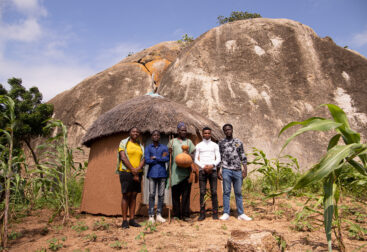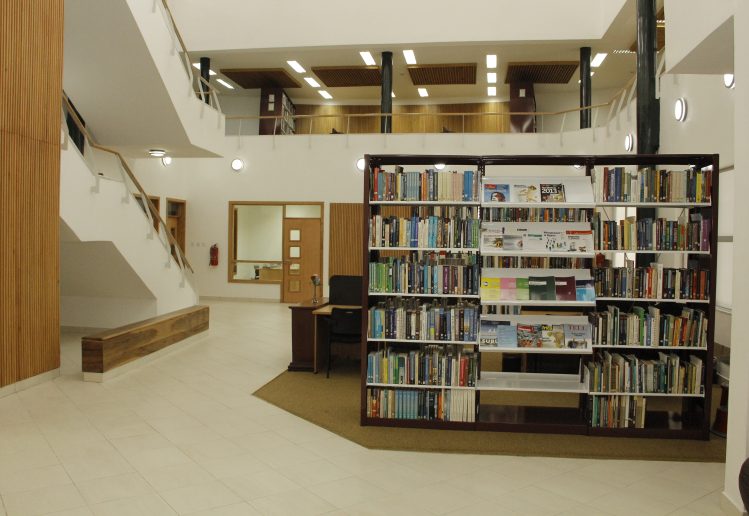
In cities like Helsinki, residents can access dozens of well-funded public libraries within a short commute. In contrast, Lagos, a city of over 15 million people, has only a handful of functioning public libraries. The disparity is sharper in rural Nigeria and across sub-Saharan Africa, where entire local government areas may have no library at all, leaving thousands of students, researchers and the general public without access to books, study spaces, or educational support beyond their schools.
This gap reflects unequal access to opportunity, learning, and social mobility. Libraries are a social and economic infrastructure that support education, human capital development, digital inclusion, and community resilience. For Nigeria and sub-Saharan Africa, rethinking libraries is a development necessity.
Why Countries Invest in Libraries
In countries with strong education ecosystems, libraries function as extensions of the education system, anchors for lifelong learning, workforce development hubs, and neutral civic spaces. Public libraries in the UK, Canada, and Europe host business clinics, digital skills workshops, and community events alongside lending books. These models demonstrate that libraries’ scale impact when they evolve alongside societal needs.
Educational Continuity and Knowledge Access
Libraries play a critical but underleveraged role in educational continuity. For young people, particularly in rural areas where schools sometimes lack basic resources and opportunities are limited compared to cities, Libraries provide access to textbooks, quiet study environments, and exam preparation support. In rural communities, a single library can serve multiple schools and villages, becoming the educational hub for an entire area. For adults, libraries enable second chances through literacy support, professional exam revision, and self-directed learning for career transitions. Human capital development does not stop at graduation.
Through membership, individuals gain shared access to resources that would otherwise be unaffordable: books and reference materials, academic and professional revision resources, and essential study spaces. In contexts where books are expensive and incomes are constrained, this membership model is an equaliser. Libraries pool resources so entire communities benefit collectively.
Bridging the Digital Divide
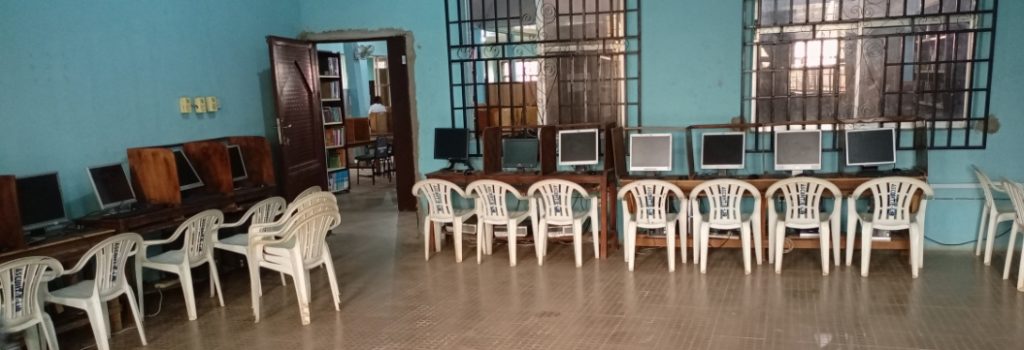
Despite widespread mobile phone usage, access to computers, stable internet, and productive digital tools remains deeply unequal, especially between urban and rural areas. Libraries can serve as community digital access points by providing shared computers, reliable internet, and basic digital literacy support.
For many Nigerians, particularly those in smaller towns and rural communities, a library may be the only place to write a CV, apply for jobs, take online courses, or access government portals. In areas where internet cafés never established a foothold, libraries can fill this critical gap.
Libraries lower barriers to digital skills development by shifting focus from individual device ownership to shared infrastructure. Through structured programs, they can support introductory computer skills, online learning pathways, and entry-level coding and data literacy.
Learning from Internet Cafés
Before widespread mobile internet, internet cafés played a vital role in Nigeria’s knowledge ecosystem. They offered affordable access to computers and connectivity, practical employment and education services, and a financially sustainable pay-per-use model. Internet cafés succeeded because they were demand-driven, service-oriented, and locally embedded. However, they lacked an educational mission, long-term stability, and public trust.
Libraries can combine the sustainability logic of internet cafés with the public-interest mandate and trust of traditional libraries by creating hybrid community knowledge and digital service centres.
Barriers and Opportunities
The current constraints libraries face include inconsistent and inadequate budgetary allocations, ageing and outdated infrastructures, such as a lack of modern amenities, internet connectivity and comfortable reading spaces, limited staffing capacity impacting effective library management and service delivery, an absence of clear policy and guidelines hampering library development and growth and low prioritisation of public knowledge institutions. These critical challenges highlight the need for collaborative efforts to address these issues.
Globally, thriving libraries diversify their services while remaining mission-driven. They could capitalise on the opportunities that exist to enhance their relevance and impact in society. These opportunities include business and workforce support, by creating co-working spaces, job search assistance, entrepreneurship resources and education support for members of their communities. They could also leverage community programming and engagement by partnering with local organisations to offer training, workshops, youth clubs, skills clinics, and outreach programs to members of their community. They could create innovation spaces for creatives, researchers, and entrepreneurs, and collaborate with international libraries and organisations to access global resources. Tiered membership models could also be created to help generate revenue while preserving equitable access to the resources they provide.
Why Physical Libraries Still Matter
Physical libraries provide what digital-only systems cannot, especially in developing and underdeveloped communities: reliable access independent of personal devices and data costs, equal access regardless of income, safe, neutral community spaces, and anchoring institutions for learning ecosystems. This is particularly true in rural areas where connectivity is unreliable and communal infrastructure often matters more than individual access.
What Must Happen Next
For libraries in Nigeria and sub-Saharan Africa to fulfil their potential, the government must integrate libraries into education, digital economy, and workforce policies with specific attention to rural library infrastructure. NGOs should pilot innovative models in underserved areas. Private sector partners can support connectivity, devices, and training. Library professionals need investment in skills and modern service design. Success requires tracking learning outcomes, digital access, employment support, and community engagement, not just book loans.
There is also significant potential for private libraries that are community-owned, membership-based, with social enterprise models that operate sustainably while serving public interest. These can emerge faster than government infrastructure, respond more directly to local needs, and experiment with hybrid models combining library services with co-working spaces, skills training, or digital access. Private libraries can fill gaps in underserved areas while demonstrating viable models that public libraries can adapt.
Libraries are foundational platforms that make education, technology, and opportunity accessible at scale from Nigeria’s largest cities to its smallest villages. Revitalising libraries is an investment in people, productivity, and long-term development. The question is no longer whether libraries are relevant but whether we will invest in making them work for everyone, everywhere. Free Knowledge Africa is building a community committed to supporting libraries and knowledge access across the continent. Join us by clicking here to become part of the movement.